


Every pool loses water. Evaporation accounts for a quarter inch per day in hot, dry climates. Splashing, backwashing, and splash-out from swimming remove additional water. The question is not whether your pool is losing water. The question is whether it is losing more than it should.
Answering this question with a calculation rather than a gut feeling is the difference between catching a leak early and discovering it after your water bill has tripled and your deck has settled.
The Bucket Test: What It Actually Measures
The bucket test is the standard method for distinguishing evaporation from leakage. You fill a bucket with pool water and place it on the pool step, then measure the water loss in both the bucket and the pool over twenty-four hours. If the pool loses more water than the bucket, you have a leak.
What most pool owners miss is that the test only works if the bucket water and pool water are exposed to identical conditions. The bucket must be filled to the same level as the pool, placed on a step where it is partially submerged, and left undisturbed. A bucket sitting on the deck, above the water line, experiences different wind and temperature conditions than the pool surface and produces misleading results.
The bucket test gives a qualitative answer: leak or no leak. It does not tell you how much water you are losing, where the leak is, or how urgent the repair is. For that, you need the evaporation calculation.
Calculating Expected Evaporation
Evaporation rate depends on water temperature, air temperature, humidity, wind speed, and pool surface area. The approximate rate for a typical residential pool in summer conditions is one-quarter to one-third of an inch per day. In arid climates with high temperatures and low humidity, the rate can reach one-half inch per day.
To calculate your expected evaporation, measure your daily water loss during a period when you are confident there is no leak. This establishes your baseline. Any water loss above this baseline that cannot be explained by backwashing, splashing, or other known causes is likely a leak.
For precision, use the Penman equation or an online evaporation calculator that takes your local weather data as inputs. For practical purposes, the quarter-inch-per-day rule of thumb is sufficient to identify suspicious water loss that warrants further investigation.
Quantifying the Leak Rate
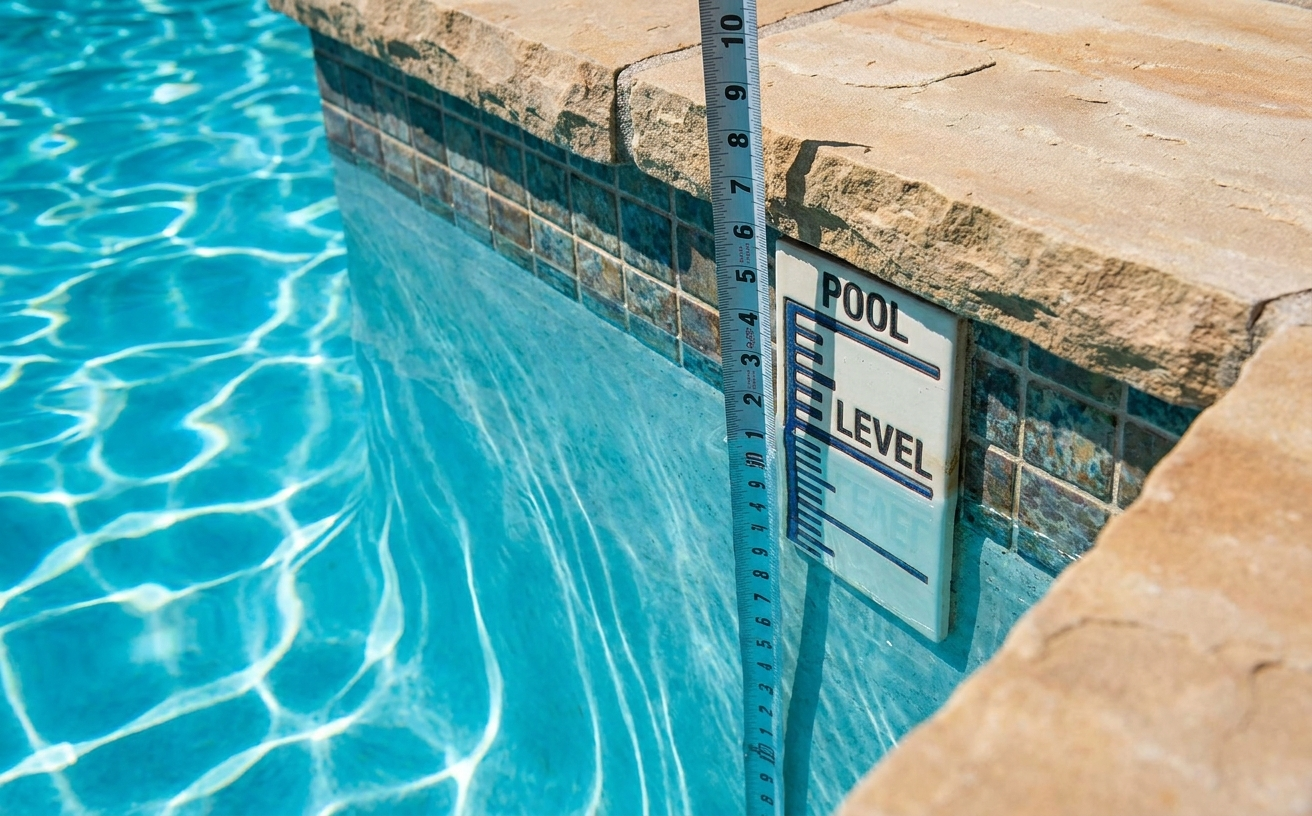
Once you have confirmed a leak, measure the exact loss rate. Mark the water level with tape or a pencil mark on the tile line. Measure the drop after twenty-four hours with a ruler. Subtract the expected evaporation rate. The result is your leak rate.
A leak rate of less than one-quarter inch per day, after accounting for evaporation, suggests a small leak in the plumbing or a minor structural crack. A rate of one-half inch or more per day suggests a significant plumbing break or a large structural failure that needs immediate attention.
Convert the leak rate to gallons per day for a more intuitive understanding. A pool with a five-hundred-square-foot surface area that loses one inch per day is losing approximately three hundred gallons. This is roughly the capacity of a large hot tub, disappearing every single day.
Narrowing Down the Location
The timing of water loss provides the first clue about location. If the pool loses water only when the pump is running, the leak is on the pressure side of the plumbing. If it loses water only when the pump is off, the leak is on the suction side. If it loses water at the same rate regardless of pump operation, the leak is in the pool structure.
The rate of loss also varies with the water level in some cases. A leak at the skimmer or return fitting may slow or stop as the water drops below the leak point. A structural crack on the floor continues leaking regardless of water level until the pool is nearly empty.
Dye testing confirms suspected leak locations. Turn off the pump, wait for the water to calm, and squeeze dye near suspected leak points. The dye will be drawn toward the leak, revealing its exact location. This is one of the most effective pool leak detection tips for confirming a suspected location before committing to a repair.
When to Stop Investigating and Call a Professional
If dye testing identifies the leak location and the repair is straightforward — a cracked fitting, a loose skimmer face plate, or a visible crack in the plaster — a competent pool owner can make the repair. These are accessible, visible problems with well-established repair procedures.
If the leak location cannot be identified with dye testing, or if the leak is underground in the plumbing, professional detection equipment is necessary. Pressure testing, acoustic detection, and helium leak detection can locate leaks in underground pipes that are impossible to find with visual methods.
The cost of professional leak detection is typically three hundred to five hundred dollars. The cost of ignoring a leak includes increased water bills, chemical waste, potential structural damage to the deck and surrounding hardscape, and the risk of the leak worsening over time. When the daily water loss exceeds the cost of detection divided by the number of days you have been losing water, the economics favor professional help.
Water loss is a number. Calculate it, compare it to expected evaporation, and let the math guide your next step. A pool that loses a quarter inch per day in summer is normal. A pool that loses an inch per day is leaking. The difference between the two is the difference between topping off the water and scheduling a repair.
